Body doubling for ADHD: how to run a session (with a script)

Body doubling means doing a task while another person is present, in the room or on a call, so their presence helps you start the work and stay with it. Agree on one task, a start and stop time, and a short check-in script; sessions commonly run 20 to 90 minutes.
A supportive strategy, not a proven medical treatment. Most of the evidence so far comes from people's own reports (Invictus Health). Use it alongside the care you already have, not instead of it.
What body doubling is
Behavioral health specialist Michael Manos, PhD, describes body doubling as a form of external executive functioning: another person helps set up an environment that prompts you to do a task you already agreed to (Cleveland Clinic: How Body Doubling Helps With ADHD). You don't have to work on the same thing. The other person's presence is what does the work.
ADDA and CHADD both describe the same pattern: pick a project, set a time, and work alongside someone who keeps you loosely accountable (ADDA: The ADHD Body Double; CHADD: Could a Body Double Help You Increase Your Productivity?).
It can look like:
- A friend on the couch while you do the dishes.
- A video call with cameras on while you each clear your email.
- A library table where strangers are working too.
- A scheduled co-working room in an ADHD community.
Why it helps some people
ADHD can make it harder to start and keep going, even when you know what to do. Another person working nearby can:
- Make the start time real, because someone expects you.
- Set the tone that you're both working now.
- Weaken the pull of random distractions for a while.
- Give you a moment to say the task out loud, which makes you name it precisely.
Cleveland Clinic notes that sessions often run 20 to 30 minutes (short), 45 to 60 minutes (medium) or about 90 minutes (longer projects), and that Pomodoro-style cycles work well with a partner (Cleveland Clinic). Invictus Health's overview is careful to say the research so far is mostly self-report, so treat body doubling as a low-risk experiment rather than a guarantee (Invictus Health overview).
A 45-minute session script
Start with this as your default and adjust the length later.
Before you start (2 minutes)
Each partner says:
"For the next 25 minutes I am working on [specific task]. My first step is [physical action]. Camera on / off. Quiet / light chat OK."
Good first steps look like this:
- "Open the tax folder and download January's PDF."
- "Put the laundry basket on the bed and sort the lights."
- "Write the subject line of the email to Sam."
Sessions stall on vague goals like "get organized" or "catch up."
Work block 1 (25 minutes)
- Keep a timer where you can both see it.
- Work quietly unless you agreed otherwise.
- Optional nudge at minute 15: "What is your next micro-step?"
Break (5 minutes)
Stand up, drink some water, stretch. Don't open the app that usually eats the rest of the hour, unless that app is the task.
Work block 2 (10 to 12 minutes)
Stay on the same task or take the next small step. Send one optional status ping near the end.
Close (3 minutes)
Each person says:
"Done: [what finished]. Stuck on: [blocker] / none. Next session: [day and time] or async follow-up: [one line]."
Then stop.
The close is part of the method. Skipping it leaves the session unfinished.
Partner agreement (fill it in once)
| Decision | Our choice |
|---|---|
| Session length | 25 / 45 / 60 / 90 minutes |
| How often | For example, Tuesday and Thursday at 8:00 |
| Camera | On / off / optional |
| Talk rules | Silence / check-ins only / light chat |
| Nudges | None / midpoint only / on request |
| Privacy | Task titles only / details OK |
| No-show plan | Text X minutes before / reschedule link |
| Off-limits topics |
Agree on privacy out loud. Plenty of people are happy to say "invoices" and would rather not say which invoice.
How to find a partner without making it weird
- Make one specific ask of one specific person. "Want to do a quiet 45-minute video co-working session Thursday at 8? We'd each mute and work."
- Use a relationship you already have: a partner, housemate, coworker, or a friend in another city.
- Join a co-working room if friends aren't available: ADHD co-working communities, study-with-me streams, library tables.
- Start shorter than you think you should. A reliable 25 minutes beats a heroic 90 that you cancel.
CHADD points to one real way this goes wrong: a session can turn into socializing instead of work (CHADD). That's what the talk rules row above is for, along with choosing a quieter partner for deep work.
Body doubling vs accountability partner vs shared routines
People use these terms interchangeably. They're related, but they work differently.
| Approach | What the other person does | Best for | Privacy |
|---|---|---|---|
| Body doubling | Is present while you work | Starting and sustaining a task | They see you work; task details optional |
| Live accountability | Hears your goal and how it went | Commitments and follow-through | You choose how much to share |
| Shared routine check-in | Learns whether a routine was kept | Habits across a day or week | Can be limited to "kept" or "slipped" |
Use body doubling when you need someone there in the moment. Use a shared-routine check-in when you want a safety net across mornings, evenings or school runs. Many people use both.
Pair it with a real plan
A body-doubling session still needs a task that fits the window. Take it from your time-blocking plan: one focus block, with its first physical action written down. If mornings are the problem, sort out your ADHD morning routine first, so the session isn't spent negotiating whether you're awake.
Do it in Unmiss
Share a routine with someone you trust
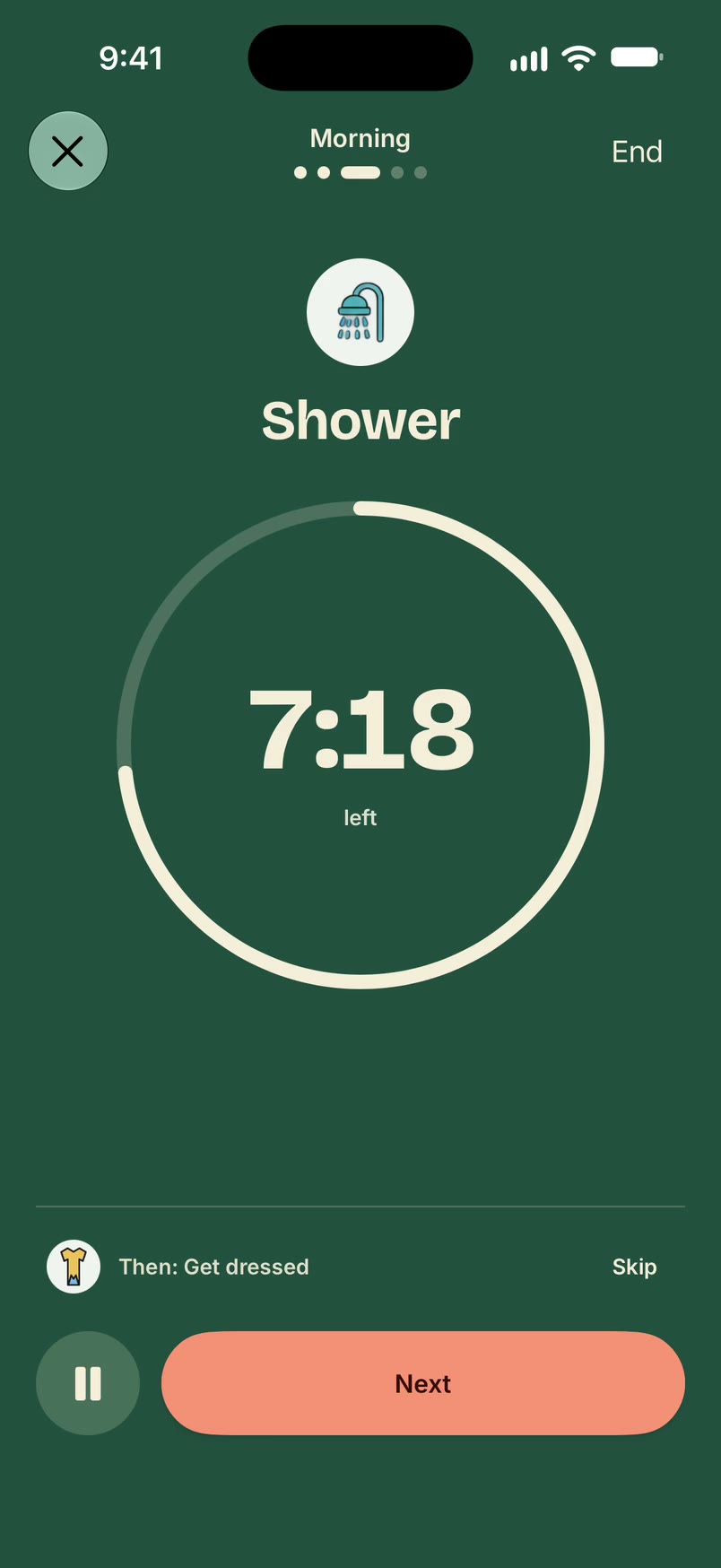
Unmiss's accountability partner feature is built for the third row of that table: you can share a routine with someone you trust, and they are told if the routine slips, not which step. That is useful when you want a light nudge without a live session and without exposing private details (medication steps, money tasks and so on).

Questions
Does body doubling have to be on video?
No. Working in person, side by side at home, or near strangers in a library can all work. Video helps when you need a scheduled start with someone far away. Cleveland Clinic suggests keeping cameras on when you use video, because seeing each other is part of the cue (Cleveland Clinic).
How long should a session be?
Try 25 or 45 minutes first. Move up to 60 or 90 only once the shorter sessions feel easy to start.
What if I get anxious being watched?
Agree on cameras off, task titles only, and check-ins at the start and end instead of in the middle. Or use a shared-routine check-in, which never reveals your steps.
Can kids use body doubling?
Yes, in a lighter form. A parent sitting nearby during homework is a classic version. Keep sessions short, name the first step, and praise the effort. CDC guidance on ADHD at home still applies: give clear directions, offer fewer choices, and break work into shorter steps (CDC).
Is this the same as having someone manage me?
No. You pick the task and you set the rules. The other person is there with you, not supervising every move, unless you ask for stronger nudges.
Sources
More guides

How to stop doomscrolling (at night and in the morning)
Stop doomscrolling at night and in the morning: a phone-setup checklist, things to do instead, and short scripts for ADHD, parents, students and work.
Time blocking without scheduling every minute
Flexible time blocking for work, school, parenting, and ADHD: theme blocks, one focus block, 25% padding, and a one-page day template.