ADHD morning routine for adults: decide it at night, run it in the morning

A good ADHD morning routine is short, decided the night before, and built around things you can see rather than things you have to remember. Keep three to five anchor steps, get clothes, meds, bag and breakfast ready before bed, and keep a 10-minute "bad day" version so one rough morning doesn't erase the habit.
Not medical advice. If your mornings involve medication, sleep problems, or mental health care, talk with your clinician about what fits your situation.
Why most morning "systems" fall apart with ADHD
A lot of morning advice assumes you wake up clear-headed with a long list of good habits ready to go. For many adults with ADHD, the hard part is starting, switching between steps, and estimating how long anything will take.
ADHD often affects executive function: planning, starting, holding a sequence in working memory, and shifting tasks. The CDC's home tips for ADHD (consistent routines, belongings kept in the same place, shorter steps, fewer choices) are written for parents of children, but the same ideas help adults (CDC: Parent Training in Behavior Management).
Time is the other piece. Meta-analyses find that people with ADHD often perceive and estimate time differently (Zheng et al., 2022, in children and adolescents; Metcalfe et al., 2023). In the morning that can show up as late starts and an optimistic "five more minutes." Timers, spoken countdowns, and padded departure times keep track of time for you, outside your head.
So skip the perfect 90-minute wellness morning. Aim for a routine you can still run on a Tuesday after a bad night's sleep.
The design rules (before you pick any steps)
Build the routine with these four rules. If a step breaks one, cut it or move it to the night before.
- Make decisions the night before. Choose clothes, breakfast, bag, and your first work task while your brain still has fuel.
- Keep three to five morning anchors. Get vertical, body care, fuel, get ready to leave, leave. Everything else is optional and goes in the "good day" version.
- Make the next step visible. A checklist on the door beats an app you have to remember to open. If you do use an app, pick one that shows one step at a time.
- Always keep a bad-day version. Ten minutes counts. Write that on the list so a short morning doesn't register as a failure.
The night-before script
Tie this to something you already do every night, such as plugging in your phone. Read it out loud the first week. After that, the order tends to stick.
- Lay out tomorrow's clothes, including socks and shoes.
- Name breakfast out loud ("yogurt and banana" works better than "something healthy").
- Pack the bag and put it on the launch pad by the door.
- Put keys, wallet, badge, headphones, and transit pass on the same pad.
- Set out medication and a glass of water where you'll see them after the alarm.
- Write tomorrow's first work or life task on a sticky note and put it on the laptop or the door.
- Set two alarms, one to wake and one for "leave now," with the leave alarm padded by 15 minutes.
- Charge the phone across the room if that helps you get up.
- Say the one-sentence plan once: "When the alarm goes off, I stand up, turn on a light, take my meds with water, and go to the bathroom."
That last line is an implementation intention, a when-then plan that takes the negotiating out of 7 a.m. Keep it to one sentence.
Morning launch checklist
Post this where you can see it from bed or the bathroom mirror. Tick steps off with a dry-erase marker or move a magnet down the list.
- Feet on the floorAlarm across the room if needed
- Light on, curtains openBefore anything else
- Water and medication (if prescribed)Already set out
- BathroomToilet and face; teeth can wait if you're short on time
- Clothes onOutfit already chosen
- Breakfast or grab-and-goAlready decided
- Launch pad checkBag, keys, phone, sticky-note task
- Leave when the leave alarm ringsDon't renegotiate
Teeth can go after breakfast or right before you leave, whichever your household already does. Don't add journaling, a workout, or inbox zero until these eight steps run on most weekdays for two weeks.
Three versions of the same routine
It's one routine in three lengths. Pick the one that fits the morning you actually woke up to.
The bad-day version still counts. A routine you do at 60% every day beats a perfect one you manage twice a month.
Worked example: a remote Tuesday
You wake at 7:45 and have a stand-up at 9:30. The night before, your clothes go on the chair, the coffee is set up so it takes one button, and a sticky note on the laptop says "open deck, write title slide." On a bad day you're dressed by 7:55, have coffee in a mug, and sit at the desk by 8:05. On a normal day you've showered the evening before, there are only two breakfast options, and a leave-the-bedroom alarm goes off at 8:10 even though you work from home. On a good day you add a 10-minute walk before opening the laptop. There's no 12-step habit stack here; the sticky note and the leave-the-bedroom alarm do most of the work.
Timers, not clocks
A clock tells you the time. A timer tells you when a step is over. Put a visible or talking timer on the steps that tend to stretch: 2 minutes for teeth, 15 for breakfast, a "leave in 10" reminder on a speaker or your phone. The same idea shows up in ADHD time blocking: pad your estimates, add transitions, and keep time outside your head (Healthline: How to Time Block with ADHD).
What to cut (and what to move)
Cut anything that needs a decision, a search, or a judgment call: choosing an outfit, hunting for keys, deciding on breakfast, a "quick" look at email or social media before you're dressed, a workout you only do when you feel motivated. Move those to the night before, to lunch, or to the good-day version. External structure (visible lists, set times, sometimes another person) can carry more of the load than morning motivation can. Cleveland Clinic makes a similar point about body doubling: having someone expect you at a set time helps you stick to a schedule (Cleveland Clinic).
If you live with kids
Run your own anchors first, even if it's only the 10-minute bad-day version, and then run theirs. Use the same order every day, keep belongings in the same place, and give short directions (CDC tips). For kids' checklists, see the guides to school mornings and a visual routine chart.
Do it in Unmiss
Run your morning one step at a time
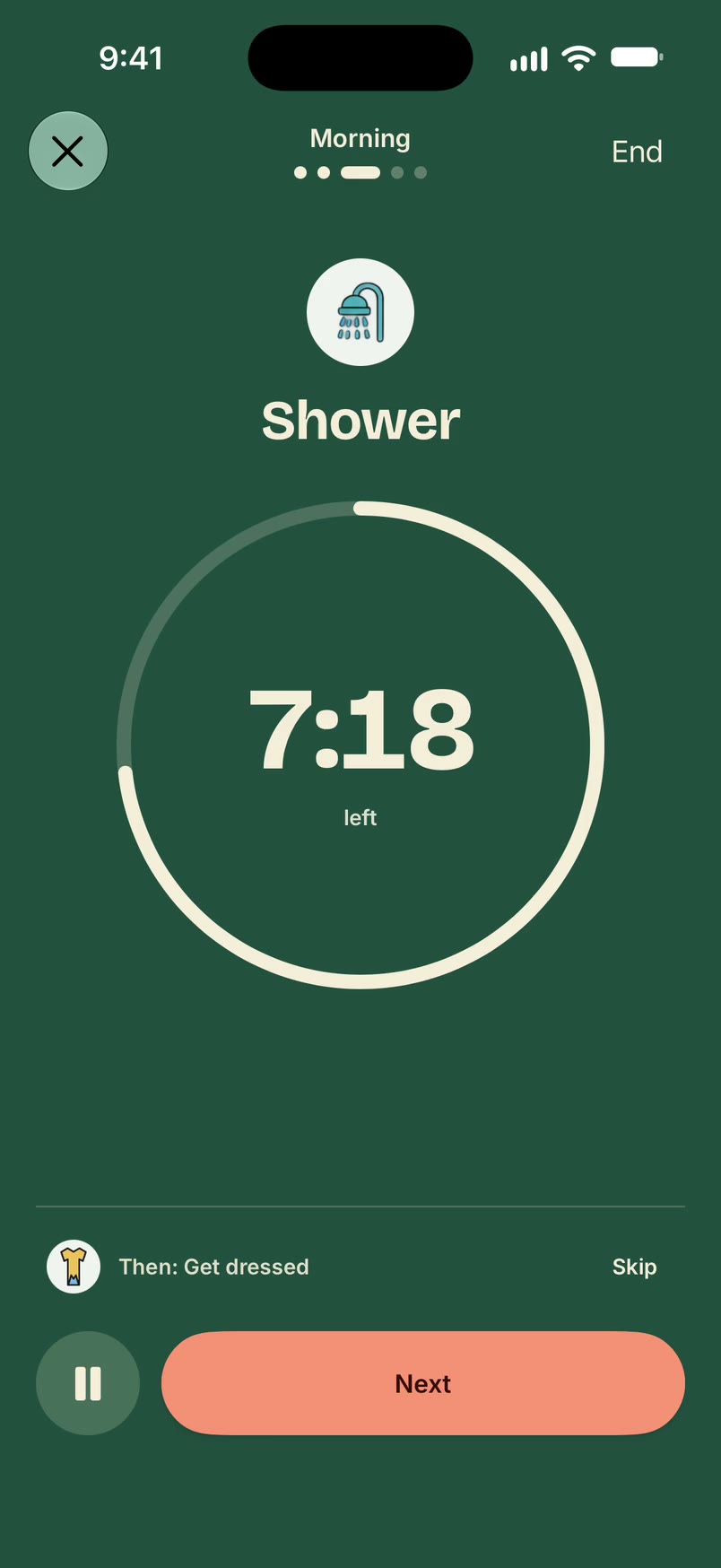
If a paper list keeps getting ignored, put the same short sequence in a routine app that shows one step at a time and can put a timer on the steps that drag (teeth, breakfast, leaving). In Unmiss, you can start a morning routine in one tap, walk through each step, and time only the ones that need it. Whatever tool you use, it should answer the "what next?" question for you.

Questions
How long should an ADHD morning routine be?
Long enough to get you out the door in working order, and short enough that you'll still do it on a bad day. For most adults that means 10 minutes on hard days and 25 to 35 minutes on normal ones. Add optional habits only once the short version is reliable.
Should I work out in the morning if I have ADHD?
Only if it already fits without a fight. If the workout is the reason you drop the whole routine, move it to lunch or the evening and protect the get-ready-and-leave anchors first.
What if I keep hitting snooze?
Put the alarm across the room, use an alarm that needs a task to dismiss, and write a one-sentence when-then plan the night before. Pair that with a bad-day version, so getting out of bed already counts as a win.
Do I need an app, or is paper enough?
For many people, paper on the door is enough. An app helps when you want step timers, a scheduled start, or the same routine on days you're away from home. Having the checklist matters more than where it lives.
Is this a replacement for treatment?
No. Routines are a support. Medication, therapy, coaching, and clinical care are separate decisions you make with professionals. For the clinical picture, the NIMH overview of ADHD is a solid place to start (NIMH: ADHD).
Sources
- CDC: Parent Training in Behavior Management
- NIMH: Attention-Deficit/Hyperactivity Disorder
- Healthline: How to Time Block with ADHD
- Cleveland Clinic: How Body Doubling Helps With ADHD
- Zheng et al., 2022: Time Perception Deficits in Children and Adolescents with ADHD (meta-analysis)
- Metcalfe et al., 2023: Time-Perception Deficits in ADHD (systematic review and meta-analysis)
More guides

Body doubling for ADHD: how to run a session (with a script)
What body doubling is, how to run a 45-minute session, a partner script, and how light accountability differs from sharing private steps.
How to stop doomscrolling (at night and in the morning)
Stop doomscrolling at night and in the morning: a phone-setup checklist, things to do instead, and short scripts for ADHD, parents, students and work.